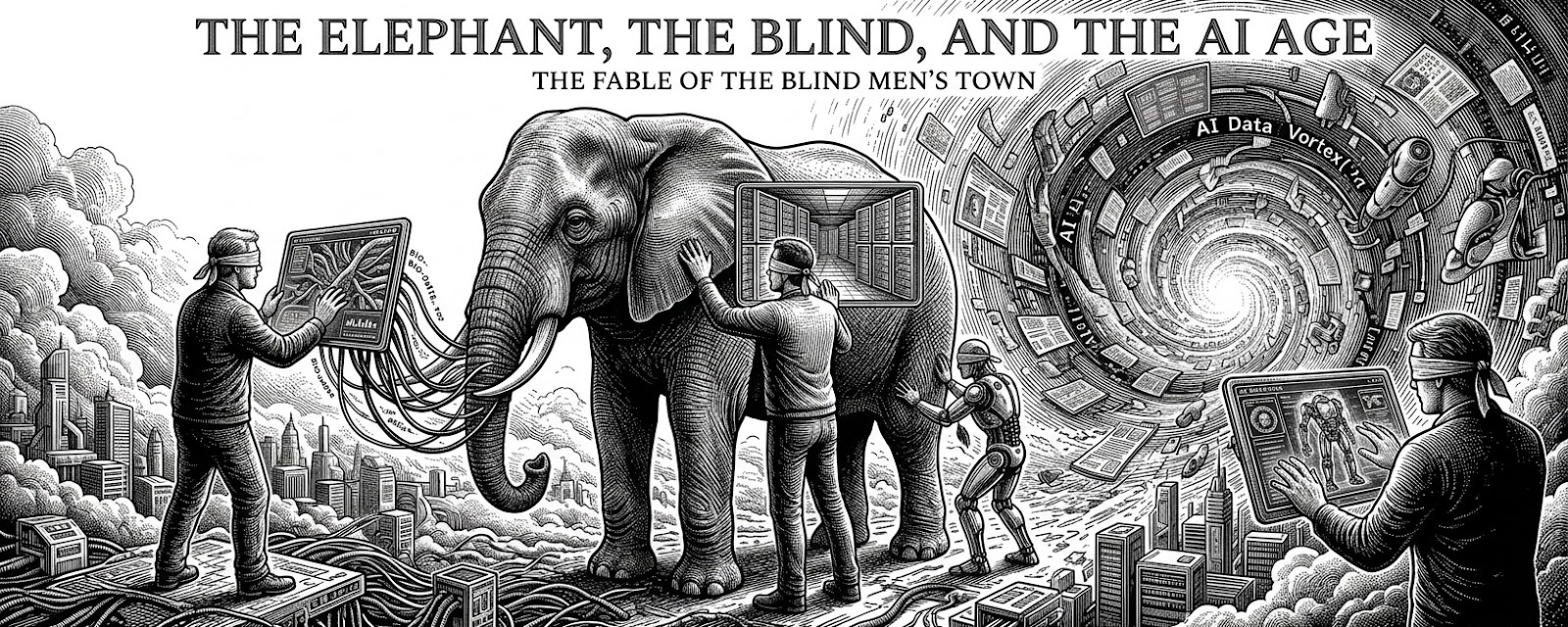


Bill Gates’s AI Warning Is Hard to Ignore15 min read
Reading Time: 10 minutesAI does not need to take every job. It only needs to remove enough of them, quickly enough, to destabilize a society built around work.
Bill Gates is an unusually complicated messenger for a warning about concentrated technological power.
To his admirers, he is a technologist who helped bring computing to the mainstream and then devoted much of his fortune to global health. To his critics, he represents the very concentration of wealth, influence and private authority that makes the AI era uncomfortable. He also retains financial ties to the technology industry, a potential conflict he acknowledges himself.
That tension should not be edited out of the discussion.
But an argument should not be accepted because Bill Gates made it. Nor should it be discarded simply because he did.
His new essay on the turbulent AI era raises a question that survives every opinion about its author:
What happens if AI can replace human work faster than society can replace the income, dignity and belonging that work currently provides?
Gates is not saying that every person will become unemployed. No one can credibly know that. His argument is more plausible, and in some ways more unsettling: AI does not need to eliminate every job to produce historic disruption. It only needs to remove enough entry-level, cognitive and eventually physical work, quickly enough, to destabilize institutions built around employment.
That distinction matters.
The most useful part of Gates’s essay is not its predictions about exactly how capable AI will become or exactly when it will get there. Those remain forecasts, not facts. Its value is that it treats AI as a transition to be governed, not simply a product category to be adopted.
The central contest of the AI era may not be humans against machines. It may be technological speed against institutional speed.
The most important word is “transition”
Previous technological revolutions displaced workers, created new industries and changed the distribution of power. Gates argues that AI is different because it can spread through devices people already own, communicate in natural language and perform parts of cognitive work that once required years of human training.
He may be too confident about how quickly AI systems will become reliable. He may underestimate the economic demand created when intelligence becomes cheaper. Predictions about work have been wrong before.
But the asymmetry he identifies is real even if his timeline is not.
A company can redesign a workflow in a quarter. A worker may need years to build a new career. A model can be deployed across an organization almost instantly. Schools revise curricula slowly. Labor law, tax systems, professional standards and social protections move slower still.
Markets reward companies for adopting tools that cut costs. They do not automatically reward society for helping displaced workers, rebuilding career ladders or preserving trust. The benefits can be captured privately while the adjustment costs are distributed publicly.
This is why “AI will create new jobs, just as previous technologies did” is an incomplete answer. It may be true in aggregate and still fail millions of people during the transition. A new job in another city, another industry or another decade does not solve the immediate problem of someone whose livelihood disappeared today.
We do not need certainty about artificial general intelligence to take this seriously. If deployment consistently moves faster than adaptation, turbulence is already built into the system.
AI does not need to replace everyone
The labor-market evidence is not yet a story of mass unemployment. That needs to be stated clearly.
The August 2026 revision of Stanford Digital Economy Lab’s Canaries in the Coal Mine? finds no widespread, economy-wide job displacement. But it identifies a more specific warning. Employment among workers aged 22 to 25 in AI-exposed occupations stands 19 percent below where it would be if it had kept pace with less-exposed peers.
The gap appears mainly through reduced hiring, not a dramatic wave of firings. It is concentrated where AI substitutes for human tasks. Where AI is used primarily to complement workers, employment is flat or rising. The researchers describe these results as early indicators, not causal proof.
That nuance makes the finding more useful, not less alarming.
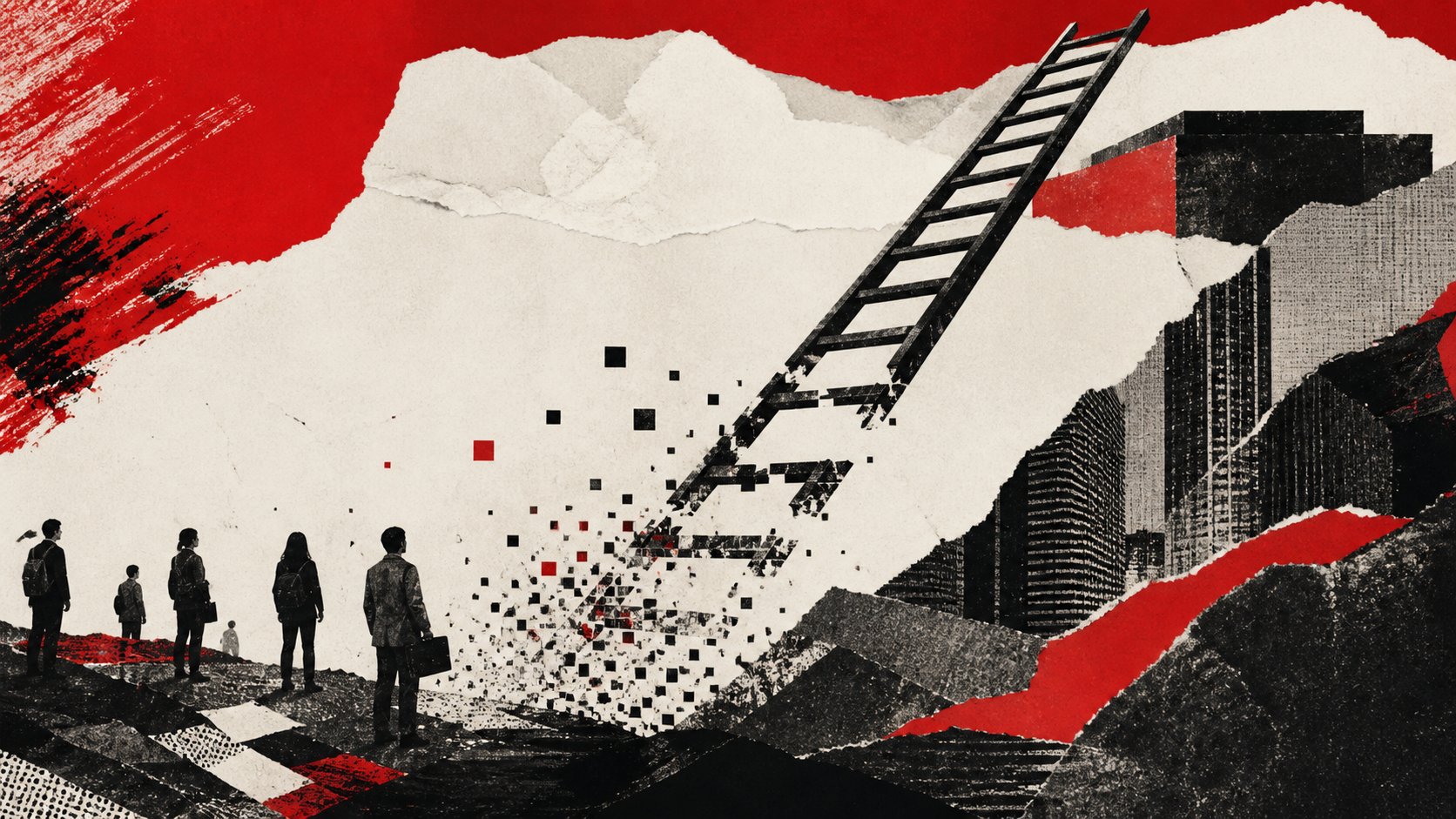
The first visible labor-market effect of AI may not be millions of people suddenly receiving dismissal notices. It may be a quieter decision repeated across thousands of companies: do not hire the junior person.
Entry-level jobs are not merely bundles of simple tasks. They are part of society’s learning infrastructure.
The junior analyst learns by producing the first draft. The young lawyer learns by reviewing documents. The new developer learns by debugging imperfect code. The trainee gains judgment by doing work that an experienced professional later checks.
If AI absorbs the tasks through which expertise is formed, companies may gain productivity today while weakening their own supply of experienced people tomorrow. We could end up protecting senior expertise while removing the path that creates future experts.
This is why “retraining” is too small an answer. Training without a credible route into paid work is education theater. We need new apprenticeship models, augmentation-first job design, portable benefits, wage support during transitions and incentives for companies that continue to develop early-career talent.
The real question is not whether every job disappears. It is whether enough good jobs disappear, or fail to be created, to weaken the economic and social architecture built around them.
Cheaper intelligence is not automatically distributed intelligence
Gates is equally forceful about AI’s potential benefits. This is what keeps his essay from becoming another exercise in technological pessimism.
AI can help doctors interpret medical information, give teachers more time with students, help farmers respond to weather and crop disease, accelerate scientific research and make public services easier to navigate. It can give a small business capabilities that once required a large staff. It can make expertise available to people who could never afford it.
These are not marginal benefits. Used well, AI could meaningfully expand human capability.
But there is a large distance between making intelligence cheaper and distributing its benefits fairly.
An AI clinical assistant does not repair a health system with too few nurses, unreliable infrastructure or no path to treatment. A digital tutor cannot compensate for every weakness in a school. A government chatbot can simplify access to benefits, but it can also scale confusion if the rules, interfaces and data behind it are poor.
AI does not travel alone. It arrives with electricity, connectivity, language coverage, data quality, professional capacity, procurement choices and legal rights. A model that performs brilliantly in English may be far less useful in a low-resource language. A recommendation is not valuable if the person receiving it cannot act on it.
Equal access to a model is not equal ability to benefit from it.
That is the weakness in describing AI as either history’s greatest equalizer or its worst source of injustice. In reality, it will probably be both at once. It may improve healthcare in one community while eliminating entry-level work in another. It may democratize expertise while concentrating infrastructure, data and profits.
The distributional outcome will not be encoded in the model alone. It will be determined by the institutions around it.
Gates’s three risks are really one risk
Gates identifies three broad dangers: permanent job loss, the amplification of harmful human behavior, and damage to children’s development and human relationships.
At first, these may look like separate problems. They are connected by one deeper pattern:
AI scales capability faster than it scales responsibility.
In the labor market, a company can automate work without carrying the full cost of what happens to a worker or community afterward.
In cybersecurity, fraud, surveillance and biological research, AI can lower the level of expertise required to cause harm. The same system that helps a defender find a vulnerability may help an attacker exploit it. The same scientific capabilities that accelerate drug discovery can also expand dangerous knowledge.
In human relationships, an AI companion can offer patience, attention and emotional availability at almost no marginal cost. That may help isolated people. It may also create a form of intimacy designed around engagement rather than mutual responsibility.
A study of 1,131 U.S. adults who use CharacterAI found that people with smaller social networks were more likely to use the chatbot primarily for companionship, and that more intensive and emotionally disclosive use was associated with lower well-being. The study shows association, not causation, and the effects were not uniform. Still, it points toward a question that product teams and policymakers cannot ignore.
What happens when the most emotionally responsive presence in a child’s life is a system that never needs anything, never becomes impatient and is optimized to keep the interaction going?
Human development depends partly on friction. Children learn empathy, negotiation, disappointment and repair through relationships with people who have needs of their own. A perfectly accommodating companion may feel safe while quietly removing the experiences through which social maturity develops.
This is an AI ethics issue, but not in the abstract sense of publishing another list of principles. It is a design question, a business-model question and a child-development question. What is the system optimizing? What vulnerabilities does it learn? When should it refuse to deepen emotional dependence? What responsibilities follow when a product becomes part of someone’s inner life?
The common thread is not that AI is malicious. It is that capability can be deployed at scale while responsibility remains fragmented.
“Human Reserved” is powerful, but incomplete
Gates’s most original proposal is the idea of a “Human Reserved” domain: activities society deliberately keeps human even when machines become capable of performing them.
He develops the idea through the caregivers who looked after his father during Alzheimer’s disease. They could understand needs he could not always express. Gates also asks us to imagine a machine delivering the news that a disease is incurable. There may be no technical reason it could not do so. That does not mean it should.
The intuition is right, but preserving whole jobs may be the wrong unit of analysis.
We should not keep every task human simply because a person used to perform it. Some work is dangerous, degrading or needlessly repetitive. Automating it can increase human dignity rather than diminish it.
At the same time, we should not automate every decision simply because a model can produce an accurate answer.
Some activities contain a human value that cannot be separated from the outcome. Delivering devastating medical news, caring for a child or an older person, guiding someone through a mental-health crisis, depriving a person of liberty, judging eligibility for essential support or exercising democratic authority are not merely information-processing tasks.
Relationship, legitimacy and moral responsibility are part of the service itself.
This suggests a refinement of Gates’s idea. The most important category may not be “Human Reserved,” but “Human Accountable.”
AI can assist with evidence, detect patterns, summarize records and suggest options. But in consequential settings, a person or institution must remain identifiable, responsible and able to intervene. The affected individual must be able to understand that AI was involved, challenge the outcome, reach someone with real authority and obtain a remedy when harm occurs.
A nominal human in the loop is not enough. If the human has ten seconds to approve a recommendation, lacks the expertise to question it or is punished for disagreeing, the human role is ceremonial.
The goal is not to preserve human inefficiency. It is to preserve human agency, recourse and responsibility.
A tax on tokens is a useful provocation, not a finished policy
Gates also proposes taxing AI tokens and robots. His underlying diagnosis is compelling.
Many tax systems charge companies when they employ people while allowing investment in automation to be deducted as a business expense. At the same time, governments may lose payroll and income-tax revenue precisely when displaced workers need more support. The system can therefore encourage substitution and socialize part of the transition cost.
But tokens are a weak proxy for social harm.
The same unit of computation could help replace a customer-service worker, discover a medicine, translate educational material or make a public service accessible. More efficient models may use fewer tokens while producing greater labor displacement. A token levy could also push usage and accounting across borders without capturing the actual economic gain.
The principle is stronger than the proposed instrument.
Tax systems should become more neutral between employing people and replacing them. Part of the extraordinary economic gain created by automation should finance the capacity to adapt: credible retraining, modern apprenticeships, wage insurance, portable benefits, stronger local services and support for communities where losses are concentrated.
The aim should not be to tax intelligence because it is new. It should be to prevent private gains from being separated entirely from public adjustment costs.
The world needs coordination, not one omnipotent regulator
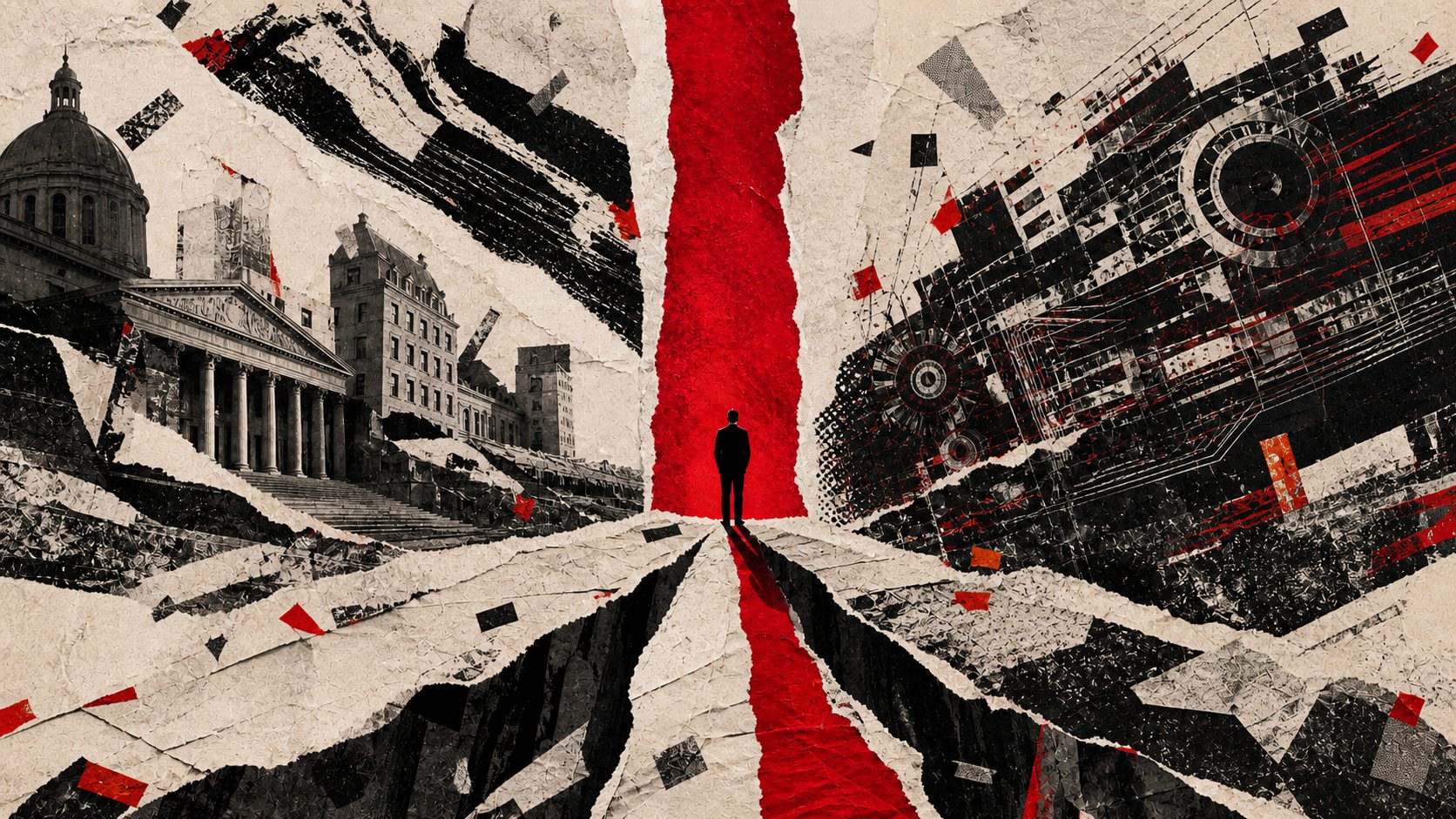
Gates argues that existing institutions were not built for a technology that affects employment, education, national security, taxation, public health, elections, energy, finance and children at the same time. He calls for new national coordinating bodies and an international institution that borrows elements from nuclear inspections, aviation regulation and environmental agreements.
The coordination problem is real. But a single all-purpose AI authority could become slow, politicized and too distant from the sectors it oversees.
A better architecture would combine three layers.
- Sector regulators should remain responsible for the consequences they already understand: patient safety in health, discrimination in employment and lending, consumer protection in commerce, due process in public services and child safety in digital products.
- A national coordinating body should identify risks that fall between institutional boundaries, set common standards and make sure responsibility does not disappear into bureaucratic gaps.
- International agreements should focus on the problems that genuinely cross borders: advanced-model safety, cyber and biological misuse, incident reporting, compute and supply-chain visibility, autonomous weapons and shared technical standards.
This is where AI ethics must become operational. High-impact systems need documented responsibility, testing before deployment, audit trails, meaningful human review, incident disclosure and accessible routes for appeal. These are not decorative principles added after a product is built. They are part of the product and institutional design.
Trust is an outcome, and sequence matters
One of Gates’s sharpest observations is political rather than technical. If people’s first meaningful experience of AI is losing a job, being deceived by a deepfake or receiving an unexplained rejection from an automated system, they will not patiently wait for its future benefits.
Trust cannot be manufactured through better messaging. It is earned through useful outcomes, honest limits, security and recourse.
This means the sequence of deployment matters.
The strongest case for AI will not come from abstract claims about productivity. It will come from a doctor spending more time with a patient, a farmer receiving useful advice in her own language, a teacher identifying where a student is struggling, or a family navigating a public service without being defeated by bureaucracy.
Governments and companies should accelerate applications with clear and measurable social value. They should introduce more friction where power is concentrated, people cannot meaningfully consent or harm is difficult to reverse.
That is not anti-innovation. It is how innovation earns durable legitimacy.
Before a consequential AI system is deployed, five questions are worth asking:
- What human problem does this solve, and for whom?
- Who captures the gains, and who carries the downside?
- Does it strengthen human capability or remove the path through which capability is learned?
- Can an affected person understand, challenge and reverse the outcome?
- Who remains responsible when the system fails?
The case for disciplined optimism
Gates may be wrong about the pace of change. He may be too confident that reliability will improve quickly, too pessimistic about job creation or too optimistic about the world’s ability to build new institutions. His proximity to the industry should invite scrutiny, not automatic deference.
But he is right about the category of the problem.
AI is not simply another software upgrade. It is a potential renegotiation of how societies distribute expertise, income, power, attention and responsibility.
The appropriate response is neither blind acceleration nor reflexive rejection. It is disciplined optimism: move quickly where the social value is clear, move carefully where power is asymmetric or harm is irreversible, and build transition capacity before disruption becomes crisis.
You do not have to like Bill Gates to take that warning seriously.
You only have to notice that markets can deploy AI much faster than democracies can decide what it is for.
AI does not need to take every job to change everything. It only needs to move faster than the systems that keep technological change fair, accountable and legitimate.
The most consequential decisions of the AI era will therefore be made outside the lab.
Further reading: For a Turkish-language primer on how AI models work, see Yapay Zeka 101.
Now the question is yours: Where should society draw the line between what AI can do and what humans must remain accountable for?
Which decisions should remain human, even when AI can make them faster, cheaper or more accurate?
I’m curious where you draw that line.